
Why Collaboration is a Business Imperative in 2026
In today’s rapidly shifting business landscape, collaboration isn’t just a leadership buzzword. It’s a commercial necessity. As leaders respond to complex global risks, economic pressure, technological acceleration and increasing social polarisation, the ability to work together across differences is emerging as a defining factor in organisational resilience and performance.
At Collaboration Equation™, we’ve always known that Curiosity, Care and Courage are core to effective collaboration. Now, the data is catching up to prove it. The commercial case for collaboration is stronger than ever.
1. The Cost of Conflict: £28.5 Billion Per Year
Recent research from ACAS revealed that over 40% of UK workers experienced some form of workplace conflict in the past year. The economic impact? An estimated £28.5 billion annually, largely due to resignations, disciplinary dismissals and sickness absences.
Conflict slows down decision-making, erodes trust, and directly contributes to disengagement and churn. Collaboration isn’t about avoiding disagreement, but about creating the conditions for constructive tension, open feedback, and shared ownership of outcomes.
That’s where Team Reset workshops and coaching sessions come in. They help leaders and teams move from defensiveness to dialogue.
2. Trust is Commercial Currency
The 2026 Edelman Trust Barometer found that 70% of people globally are hesitant or unwilling to trust someone who has different values or backgrounds. This "insular mindset" is a commercial risk. It blocks collaboration, innovation, and agility.
Companies can no longer afford cultures where belonging is conditional and feedback is filtered. Trust enables performance. As Richard Edelman put it, “Insularity is a bottom-line issue, undermining productivity, causing churn, and threatening the basic ability to lead.”
Our Collaboration Equation framework is designed to build trust by developing the mindsets and behaviours of Curiosity, Care and Courage. These are not soft skills. They are commercial strengths.
3. Culture is Now a Reportable Business Asset
According to the 2026 WEF Global Risks Report, values-based conflict and political polarisation are shaping the organisational climate. The UK’s Corporate Governance Code (2024) now requires quoted companies to report on how they are embedding culture.
This is a turning point. Culture has moved from a "nice to have" to a governance and performance priority. And culture is built – or broken – through everyday collaborative behaviours. How we listen, speak, include, challenge and make space for difference.
4. Managers Shape Outcomes at Scale
Gallup’s latest research shows that manager capability is one of the strongest predictors of engagement and performance. The five traits most correlated with success? Motivation, workstyle, initiation, collaboration, and thought process.
As team sizes grow, these traits don’t just influence team culture – they amplify it. Effective collaborative leadership scales. So do blind spots.
One standout Gallup insight: 67–70% of employees feel engaged when they receive meaningful feedback weekly. Without it? Engagement drops to 22–26%.
We help leaders build the confidence and capacity to give and receive impact feedback through our inclusive dialogue practices – a core pillar of the Collaboration Equation™.
5. Transformation is Human-Centred
According to the PwC Global CEO Survey 2026, nearly 4 in 10 CEOs believe their company may not be viable in ten years without transformation. Those same CEOs now spend an average of 37% of their time on 1–5 year strategic horizons.
Research from EY and the SAID Business School concludes that successful transformation is human-centred. Change that sticks is built on connection, communication, and co-creation.
These are precisely the conditions our Team Coaching and leadership development programmes are designed to foster.
6. In the Age of AI, Human Leadership is the Advantage
McKinsey notes that the leaders who will thrive in the AI era are those who combine human depth with digital fluency. They will "think with AI, not delegate to it," and use their human capabilities to set purpose, build relationships and make values-based decisions.
Similarly, the Royal Foundation's Centre for Early Childhood recently published The Human Advantage, arguing that success with AI will depend on doubling down on human strengths, not outsourcing them.
At Collaboration Equation, we believe that how we lead matters just as much as what we are leading. Curiosity opens learning. Care builds belonging. Courage creates clarity. Together, they drive performance.
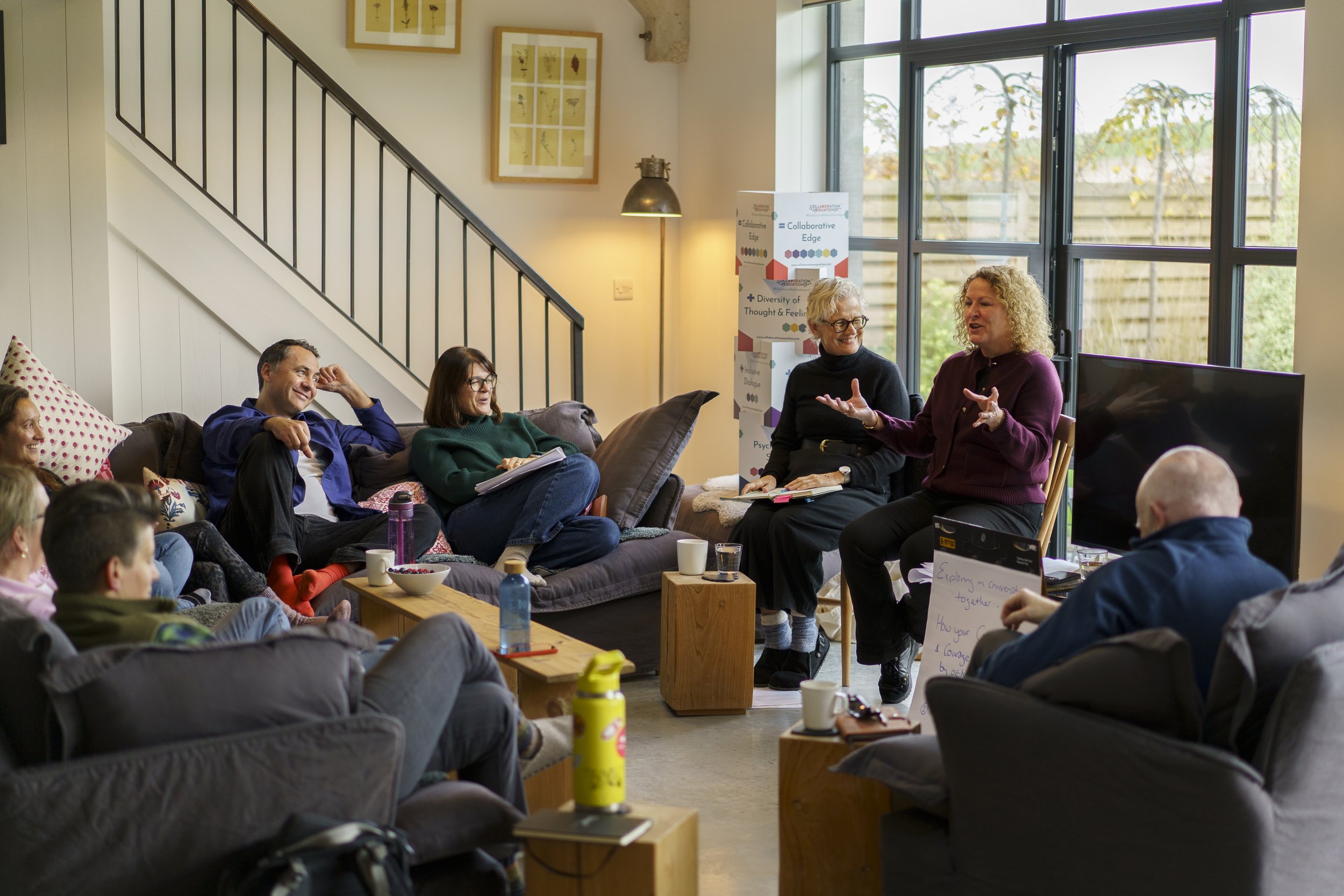
Collaboration is a Commercial Imperative
With the pressures of polarisation, AI, cultural divergence and economic uncertainty rising, the ability to collaborate across differences isn’t just a nice-to-have. It’s a business imperative.
Leaders are being called to create environments where people:
Feel safe to contribute,
Are clear on their shared purpose,
And are energised by co-creating value.
This is what it means to find your Collaborative Edge.
Ready to Collaborate Better?
If you’re a senior leader, team manager or HR/OD professional navigating complexity, now is the time to invest in building collaborative capacity.
Let’s start with a conversation. Explore how our leadership development and team coaching experiences can support your team or organisation.
Get in touch to book a discovery call or learn more.
A special mention to John Drummond for collating some of the above research and sharing so generously.