
Is trust the missing piece in your team?
A short guide for leaders navigating change, by Anni Townend and Lucy Kidd, Collaboration Equation®
Most leaders we work with are not short of effort. Neither are they short of capability, commitment or care for the people around them.
What they often notice, and sometimes only in passing, is that something is not quite landing. The team is not working as well as it could. People are contributing carefully rather than fully. Conversations remain at surface level when something more honest is needed.
The word for what is missing is usually trust.
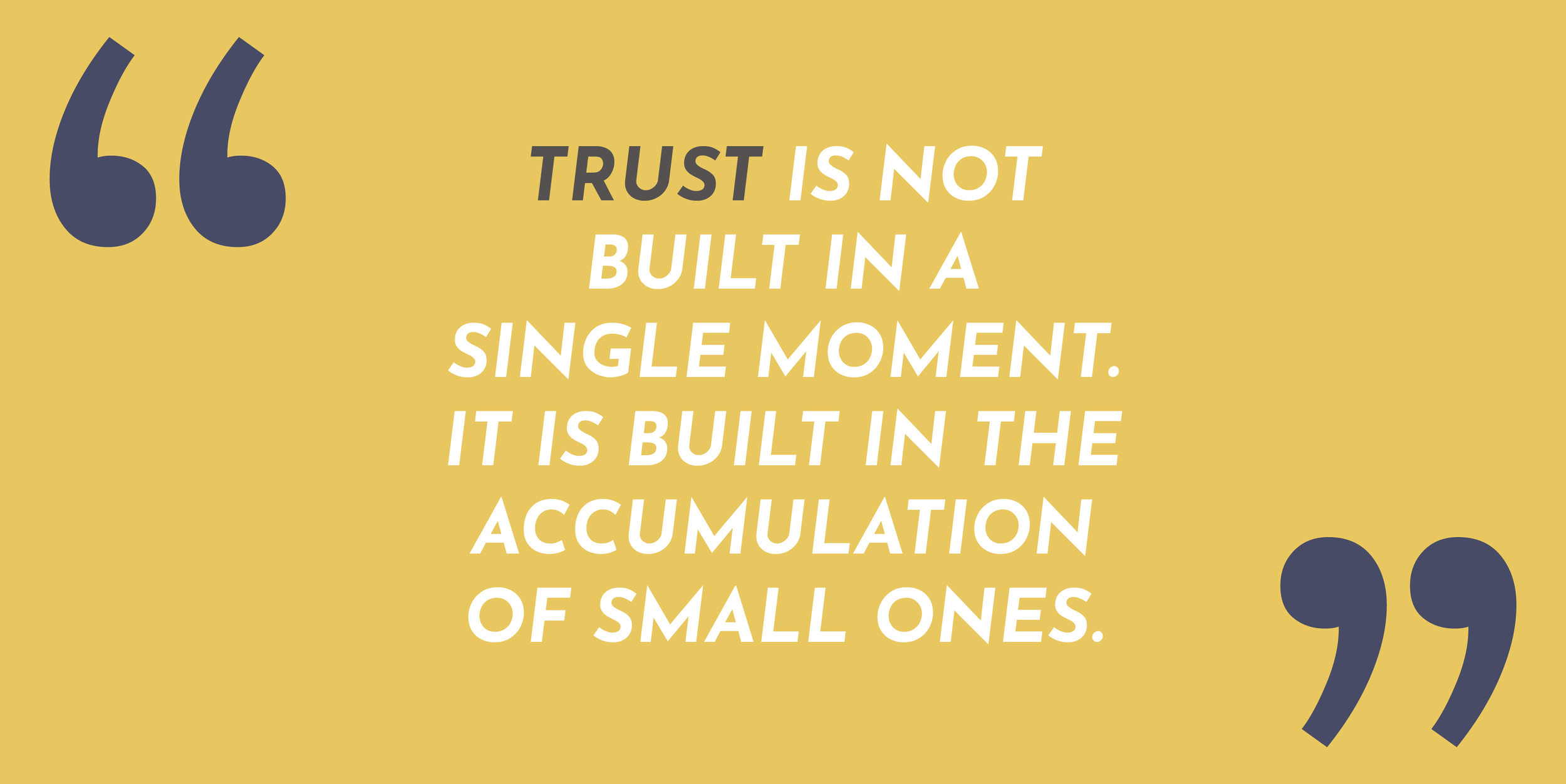
Trust is built in small moments
In the accumulation of consistent, everyday behaviour. Whether people feel genuinely seen or just managed. Whether difficult things get said or set aside.
This is harder to build than it sounds, particularly when your team is changing. When new people join, and others leave. When the organisation itself is in motion. When you are expected to hold a level of confidence you do not always feel.
The three behaviours at the heart of Collaboration Equation: Curiosity, Care and Courage, are also, in our experience, the three that build trust most reliably over time.
What is in the guide
We have written a practical guide for leaders on how to build trust in a team, covering the specific behaviours that make a difference and the ones that gradually erode what you are trying to create.
It includes what actually builds trust and why consistency matters more than almost anything else, how to move quickly when your team is new or changing, the behaviours that erode trust without most leaders realising, three questions to consider, and a short FAQ written for the questions leaders actually ask.
If you are leading a team through change and trust feels like the missing piece, this is for you.
Download the guide: How to Build Trust in a Team
How do you build trust in a team quickly?
Building trust quickly requires consistency more than anything else. Do what you say you will do, even in small things. Listen more than you speak, particularly if you are new to the team. Name what is happening, including the difficulty of transitions. Create space for real conversation beyond the agenda. And be honest when you do not have answers. Trust accelerates when people feel seen, heard and not misled.
Why is trust important in a team?
Trust is the foundation for almost everything that makes a team work well. Without it, people hold back their best thinking, avoid difficult conversations, and manage upwards rather than contributing honestly. With it, teams can navigate uncertainty, have the conversations that matter, and do genuinely collaborative work. Research consistently shows that trust is one of the strongest predictors of team performance and individual engagement.
What destroys trust in a team?
The most common trust destroyers are: inconsistency between what a leader says and does, feedback that only flows in one direction, decisions made without explanation, pace that leaves no room for real connection, and important things being left unsaid. Most leaders who exhibit these behaviours are not doing so deliberately. But the effect on trust is significant and cumulative.
How do you rebuild trust in a team after it has broken down?
Rebuilding trust starts with acknowledging what happened. Not in a general way, but specifically. What was the break? What was the impact? Leaders who try to move past a breakdown of trust without naming it tend to find the trust does not rebuild. After acknowledgement comes consistent behaviour over time. Trust is rebuilt slowly, through repeated experience that things have genuinely changed.
What is psychological safety and how does it relate to trust?
Psychological safety is the belief that it is safe to speak up, take risks, ask questions and make mistakes without fear of humiliation or punishment. It is closely related to trust but not identical. A team can trust their leader personally but still not feel safe to challenge a decision or admit uncertainty. Building psychological safety requires all three of the behaviours in Collaboration Equation: Curiosity to explore possibility, Care to deepen connection, and Courage to model vulnerability and open conversation
How do you build trust in a hybrid or remote team?
Hybrid and remote teams face particular challenges because so much of what builds trust naturally, the informal conversation, the shared experience, the small moments of connection, happens less or not at all. Leaders of hybrid teams need to be more intentional about creating the conditions for connection. This means not letting every interaction become purely transactional, finding ways to have real conversations even on screen, and being especially consistent in communication and follow-through when people cannot see you day to day.
If something in the guide resonates with where you and your team are right now, we would love a conversation.
Get in touch to find out more about how we work.
-
Building trust quickly requires consistency more than anything else. Do what you say you will do, even in small things. Listen more than you speak, particularly if you are new to the team. Name what is happening, including the difficulty of transitions. Create space for real conversation beyond the agenda. And be honest when you do not have answers. Trust accelerates when people feel seen, heard and not misled.
-
Trust is the foundation for almost everything that makes a team work well. Without it, people hold back their best thinking, avoid difficult conversations, and manage upwards rather than contributing honestly. With it, teams can navigate uncertainty, have the conversations that matter, and do genuinely collaborative work. Research consistently shows that trust is one of the strongest predictors of team performance and individual engagement.
-
The most common trust destroyers are: inconsistency between what a leader says and does, feedback that only flows in one direction, decisions made without explanation, pace that leaves no room for real connection, and important things being left unsaid. Most leaders who exhibit these behaviours are not doing so deliberately. But the effect on trust is significant and cumulative.
-
Rebuilding trust starts with acknowledging what happened. Not in a general way, but specifically. What was the break? What was the impact? Leaders who try to move past a breakdown of trust without naming it tend to find the trust does not rebuild. After acknowledgement comes consistent behaviour over time. Trust is rebuilt slowly, through repeated experience that things have genuinely changed.
-
Psychological safety is the belief that it is safe to speak up, take risks, ask questions and make mistakes without fear of humiliation or punishment. It is closely related to trust but not identical. A team can trust their leader personally but still not feel safe to challenge a decision or admit uncertainty. Building psychological safety requires all three of the behaviours in Collaboration Equation: Curiosity to explore possibility, Care to deepen connection, and Courage to model vulnerability and open conversation.
-
Hybrid and remote teams face particular challenges because so much of what builds trust naturally, the informal conversation, the shared experience, the small moments of connection, happens less or not at all. Leaders of hybrid teams need to be more intentional about creating the conditions for connection. This means not letting every interaction become purely transactional, finding ways to have real conversations even on screen, and being especially consistent in communication and follow-through when people cannot see you day to day.